
“Four! No, five. Wait. Let me count.” Landon thought we were playing a game, but I knew we were strengthening his number sense by practicing subitizing. I watched his wheels turn as he pointed to the dots and counted.
In my kindergarten classroom, the children would get a glimpse of a dot card and tell me how many dots they saw. We were working on subitizing and strengthening our number sense skills.
What is Subitizing?
Subitizing is the ability to instantly know how many objects there are without counting. Think of dice. When you roll a die, you don’t have to count the dots because your brain automatically recognizes the pattern.
There are two ways we subitize. The first, and simplest, is when we see a pattern and automatically know how many, like a dice.
The second way we use subitizing is when we see a larger pattern and are able to break it up into smaller groups to know how many. If I see 9 dots, I might see a group of 4 and a group of 5. I know that 4 and 5 is the same as 9, so I know I have 9 dots.
Why is Subitizing Important?
When children can see numbers in patterns they have strong number sense skills overall. Strong number sense is required to count on, add and subtract mentally, and recognize patterns.
When Can Children Start to Subitize?
Children can start subitizing between the ages of 3-4. When working with younger children, start with subitizing up to 5. As you work on numbers larger than 5, practice breaking up the items into two smaller groups and adding them together. As they develop their skills, work on subitizing to 10.

Activities to Build Subitizing Skills
As an Amazon Associate, I earn from qualifying purchases at no additional cost to you.
1. Dice Games
Any games that use dice are great practice for subitizing, but these are our favorite.
Math Dice Jr. uses a 12 sided die and 5 regular dice to help children practice mental addition to move up the scoring track.
2. Card Games
You can play many games using these cards, or any cards similar to these.
- 3 Second Game– Children love the challenge of getting a glimpse of a card, “taking a picture in their mind,” and then trying to figure out how many dots they saw.
- Matching– Have your child put all of the cards that represent the same number in a pile or line so they can see different ways the numbers are represented.
- Memory– Use the cards above to play a game of memory. You might be matching 6 dots with the numeral 6. This works well because they can see different ways to show the same number.
- How Fast Can You Find it? Lay dot cards out on the floor. Call out a number and have your child find the corresponding dot card as quickly as they can.
- War– Using the dot cards play war. Subitize the number, and discuss who has more/less.
3. Videos
I’m not a fan of a lot of screen time, but these videos make subitizing more fun.
- Subitize Rock by Jack Hartmann
- Subitize Up to 5 by Jack Hartmann – This one uses 10 frames which can be helpful for beginners!
- Subitize Super Fast to 10 by Jack Hartmann
- Apple Subutizing by Greg Smedley-Warren
4. Using Manipulatives
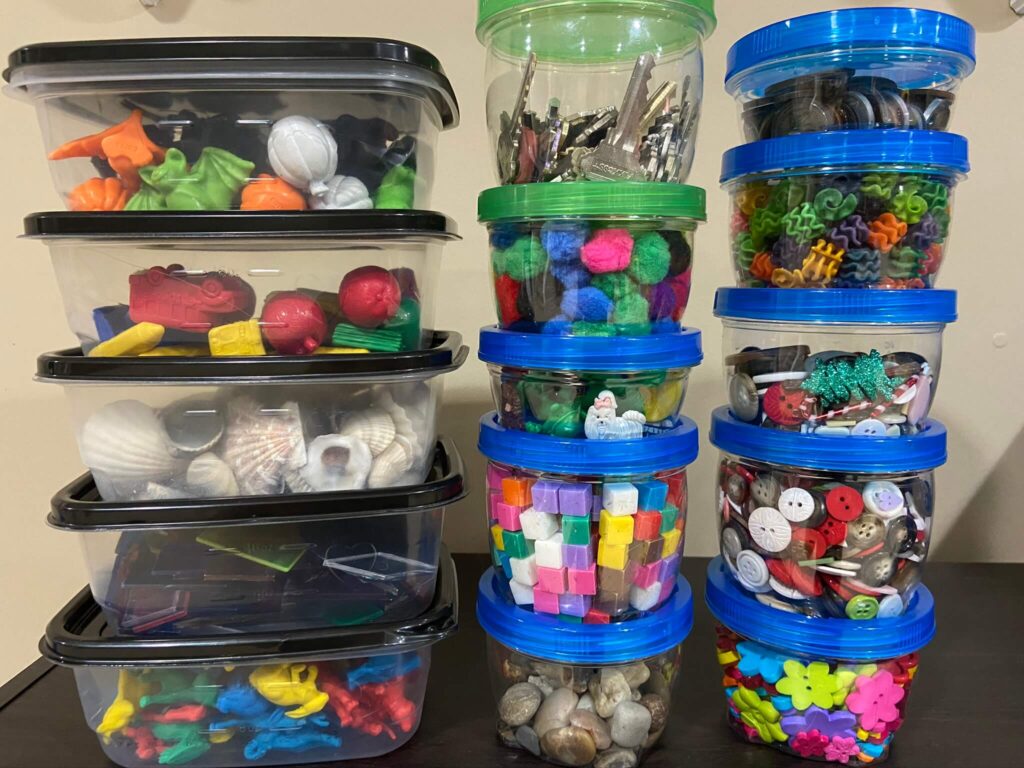
Collect different types of manipulatives and make junk boxes. Keys, lids from applesauce pouches, coins, and small toys work great for this. Put 10-15 items in each container.
- Have your child pull out a handful. As they drop their items on the table, let them look for 2-3 seconds, and cover up the items. Tell them to take a picture in their head of the items, and ask them how many there are. After they have answered, uncover the items and count.
- Give your child a set number of manipulatives and ask them to put the items into a configuration. Ask them how many they have, and then ask them to rearrange the same number of items into a different configuration.
Counting Bears – We love manipulatives like this, they are fun for math practice and fun to play with.
All About Me Family Counters – These are fun for children to learn all about their family and pets
Wooden Pattern Blocks – Pattern blocks build shape, color, and number recognition skills, not to mention encouraging creativity and imagination!
5. Dominoes
Dominoes is a great way to practice subitizing. Play as they are intended, or you can have your child add the dots on the domino and put dominoes with the same number of dots together.
6. Play-Doh
- Call out a number and have your child make that number of play-doh balls. They can arrange them in any configuration they would like. When they are done, they can rearrange them to a different configuration.
- Flash a dot card (from above) quickly and have your child replicate the pattern with their playdoh balls.
As With All Learning…
Anything you try to work on with your childr is more effective when you make it fun. Make up your own games and most of all just enjoy time together. You will love seeing their confidence grow as they quickly grasp new concepts and strengthen skills!
Want More?
If you liked this, you’ll love:
4 Ways to Help Your Kindergartener With Math
Addition for Preschoolers: What You Must Know
Recognizing Numbers: Teaching your Child Number Recognition
Your Turn
What are your favorite games to teach subitizing?